November 14, 1997
Contractor Randy Pomeranz begins to fabricate the walls for the KNOM transmitter site’s generator shed. Time – and the remaining days of temperate weather – are running out, and the 66-kilowatt generator is waiting to be installed.
November 14, 1997
Contractor Randy Pomeranz begins to fabricate the walls for the KNOM transmitter site’s generator shed. Time – and the remaining days of temperate weather – are running out, and the 66-kilowatt generator is waiting to be installed.
October 31, 1970
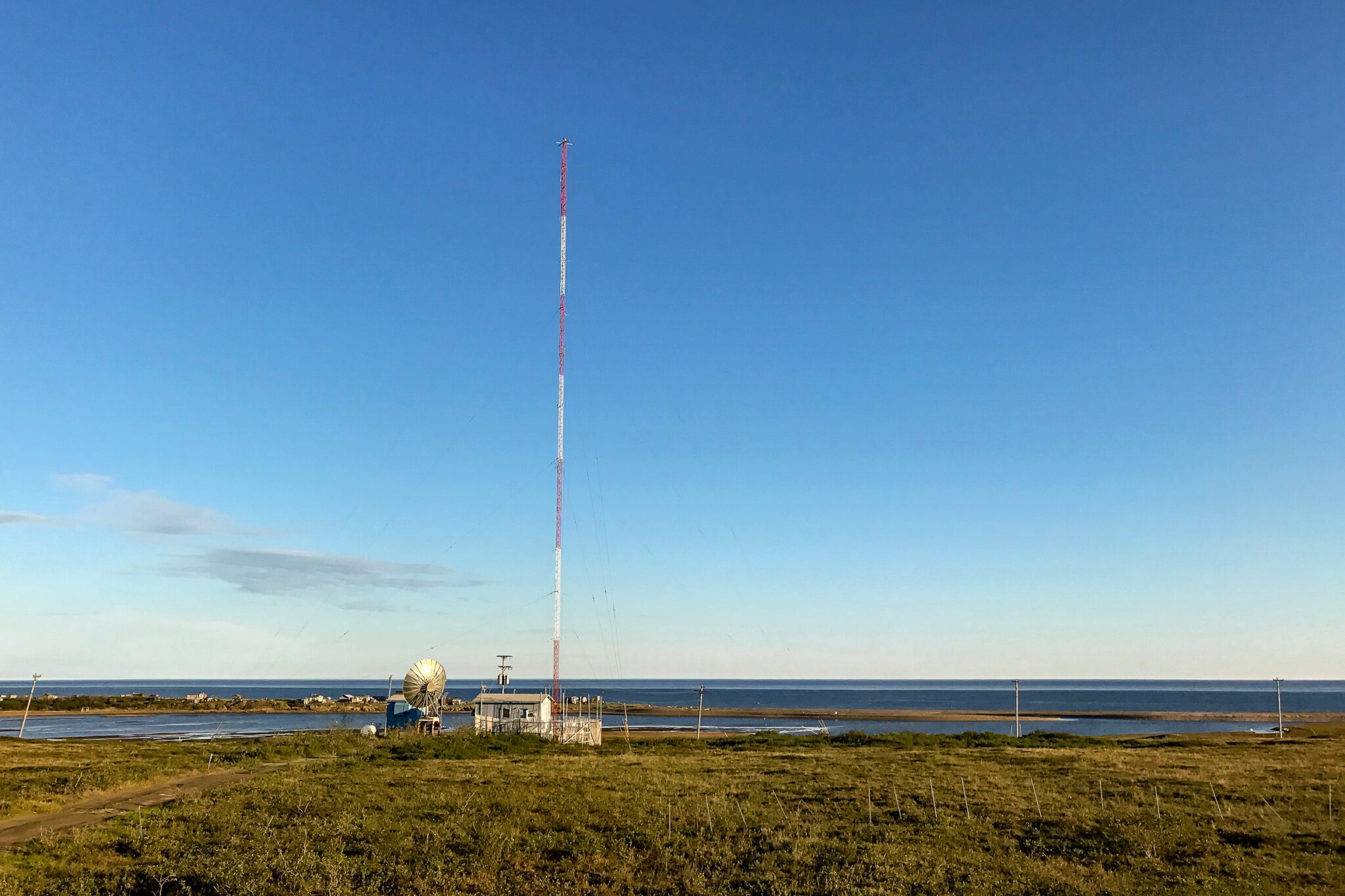
The AM tower construction is complete. Nome Joint Utilities runs a power line across the tundra to the tower, and it is lighted. It’s finished just in time. Two days later, blizzards shut down Nome for almost three weeks.
September 25, 1997
Chief engineer Les Brown (pictured) has almost single-handedly built the extended fence around the AM tower, preparing for the mission’s higher-power, 25,000-Watt signal. Snow drifting has always been a problem there, and Les tries an innovative solution.
For (fence) pickets, he uses 1/2-inch plastic pipes, which he figures will be aerodynamic and won’t stop as much snow as wooden slats. It turns out to be an excellent decision. The needed material costs $931, and by doing it himself, Les figures he is saving the mission about $4,500 in labor.
Last week, we welcomed the last of this year’s five volunteers to Nome. Lucus Keppel is from Michigan and has committed one year to the KNOM Radio Mission. He joins Margaret, Eva, Dayneé, and Josh. They look forward to a wonderful year of service to listeners in remote bush communities.
As always, we thank everyone who helps us overcome each obstacle and meet every challenge. Sometimes, our challenges are of a technical nature.
Recently, KNOM’s AM transmitter shut down, and the sensor monitoring the temperature inside our transmitter building read 128 degrees! The fans had turned off and had failed to restart. After cooling the building, engineering volunteer Rolland Trowbridge located the reset switch in a control panel and restarted the AM transmitter, returning the KNOM signal to the air.
In the rare moments our AM signal goes offline, we often receive phone calls from listeners asking us “where did you go?” We’re gratified to have such devoted listeners – and dedicated volunteers, staff, and community members who make sure such outages are not just rare, but also brief.
August 23, 2009
The transmitter fails this morning, just as the automated remote control commands the increase to daytime power. From Anchorage, Tom Busch talks general manager Ric Schmidt into coaxing it to operate at very low power, about 2,000 watts. After flying to Nome, Tom discovers that a jumper cable 100 feet above ground has severed. Due to high reflected power, the station might be actually transmitting at only a handful of watts.

In the summer of 1999, Anchorage tower contractor Rod Ewing steadily paints the KNOM transmitter tower, foot by foot.
July 21, 1999
Rod Ewing begins to apply a new coat of paint to the KNOM tower. How do you paint a tower? “The first thing you do,” Rod jokes, “is take a bucket of paint and pour it over your head, so you get that part taken care of right off the bat.” Actually, it’s tedious work, using cotton mittens, taking about two minutes per foot of tower.

Chuck Lakaytis, Les Brown, and Rolland Trowbridge (left to right) in the midst of installing the power management system known as dynamic carrier control at KNOM’s AM transmitter.
We so appreciate everyone’s support for KNOM and for our efforts to trim energy costs.
With the cost of gasoline at almost $6 per gallon here in bush Alaska, you can understand why we are looking high and low for ways to save.

Sally Duggan, Kitty Orris, and Ida Schilter: three of the 71 nurses who, during KNOM’s first 15 years, supported the station by donating their entire salary to the radio mission. The nurses worked at Nome’s hospital but lived in KNOM’s volunteer housing.
July 13, 1971
One day before scheduled sign-on, a copper strap burns apart in the antenna tuning unit, removing the antenna from the transmitter. Six small resistors burn in the transmitter’s final section. In isolated Nome, they are impossible to replace.
However, support nurse Kitty Orris (pictured, in the middle of the photo) has just escorted a patient to Anchorage, where she is able to purchase the parts for transport by air the next morning.

Volunteer engineer Les Brown reviews technical information while helping to install dynamic carrier control at the KNOM AM transmitter.
The temperatures have risen to almost 70 degrees! We are blessed with warmer temperatures and, at times, sunshine.
We have great news. At the end of April, volunteer engineer Les Brown, longtime Alaska radio engineer Chuck Lakaytis, and maintenance specialist Rolland Trowbridge installed dynamic carrier control equipment at our AM transmitter site.
Feel free to use the inspirational spots you find on this blog - or in our Inspirational Spot Library - in your church bulletin, newsletter, or other small-scale, not-for-profit publication or website.
Please always attribute any spots you may use to KNOM Radio Mission and to knom.org.
(All other content - photos, text, video, audio, etc. - is all rights reserved. Please contact us if you have any questions.)


